
Who Wrote This?
When AI detection starts judging the writer instead of the writing

Recently, Substack provided readers with a new button.
“Scan for AI text.”
Naturally, I pushed it.
Because apparently I have reached the stage of adulthood where I voluntarily ask a computer to judge whether another computer helped me write something.
The result was interesting.
Parts of my writing were identified as AI-assisted.
Technically, that’s true.
I use AI a lot, for research, challenging ideas, finding holes in an argument, cleaning up sentences, catching repetition, and reorganizing sections. Occasionally, it tells me the paragraph I’m irrationally attached to really does need to go.
Sometimes I listen, sometimes I don’t, and sometimes I put the damn sentence back.
That’s writing.
At least I thought it was.
Then I ran across something else.
Claude, Anthropic’s AI assistant, is beginning to watermark AI-generated text.
Not with some hidden “MADE BY CLAUDE” label buried in the document. The watermark is designed to be imperceptible to the reader while still leaving a detectable signal in the generated language.
Google has already been doing something similar with SynthID in Gemini.
I understand why.
AI-generated spam, fake reviews, academic cheating, misinformation, and impersonation are real problems. Being able to identify material generated by an AI could be useful.
But I couldn’t stop thinking about the other side of it.
What happens when the AI didn’t write the original, but only helped?
Suddenly I found myself asking a question I hadn’t really considered before:
What happens when the tools helping us write start leaving fingerprints on the work?
The Robot Around the Corner
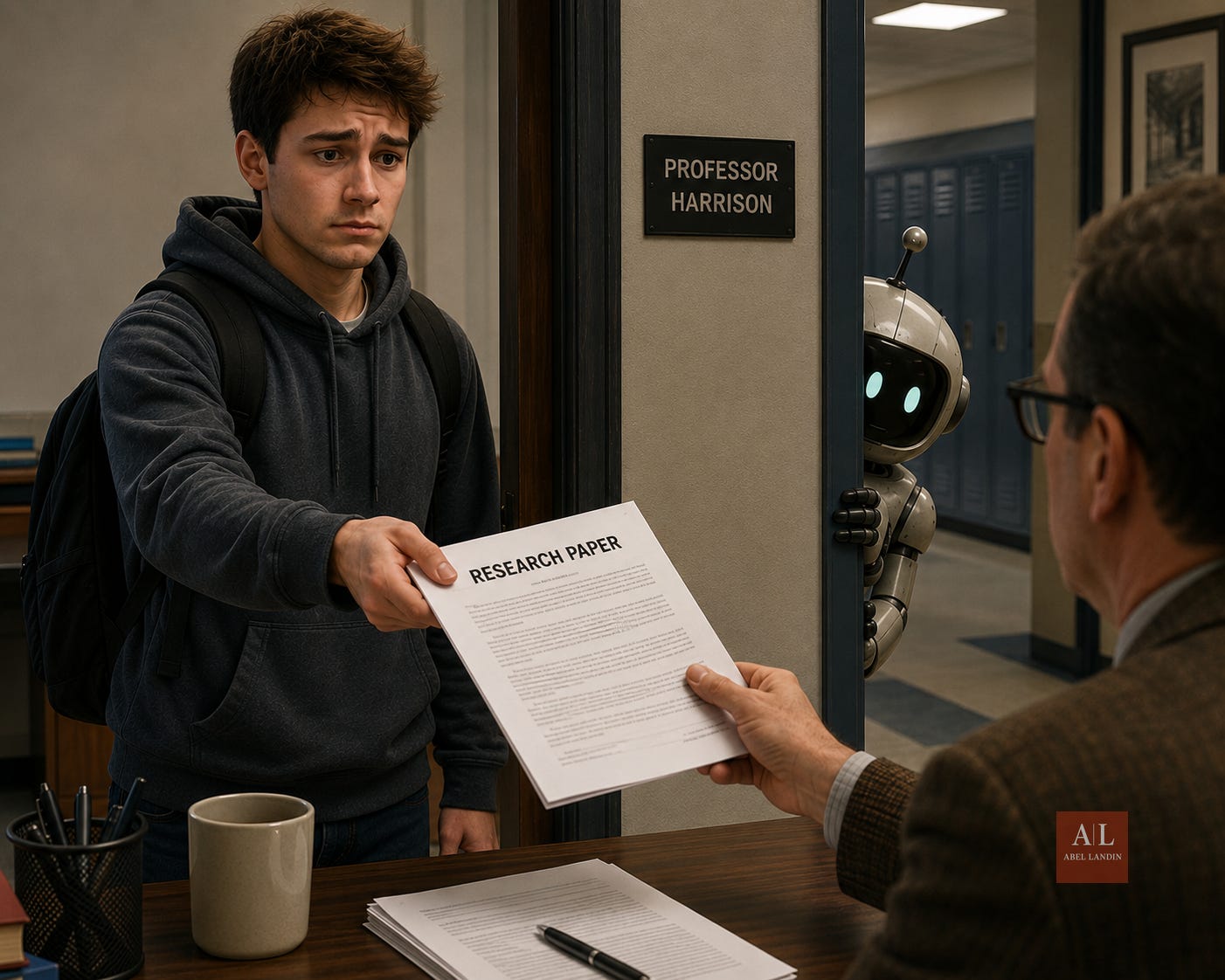
Imagine a college student turning in a research paper.
The student did the research, developed the argument, and wrote the first draft, then gave it to an AI with some simple instructions:
“Clean this up. Fix the grammar. Point out repetition. Help me make the argument clearer.”
The AI does exactly that.
The student reviews the changes, rejects some, accepts others, rewrites a few paragraphs, and turns in the paper.
An AI detector analyzes it.
“87% AI.”
There’s our student standing there holding the paper, while somewhere behind the corner a little AI robot peeks out.
Gotcha.
Except, gotcha doing what?
Using an editor, using a tool, or cheating?
Those are not the same thing, yet we’re rapidly building technology that isn’t particularly good at distinguishing between them.
Detection and Watermarking Aren’t the Same Thing
There is an important distinction here.
AI detection looks at finished writing and essentially says, “This looks like something an AI might have written.”
That’s an inference.
Watermarking is different. The generating system deliberately leaves behind a signal designed to be detectable later.
A watermark might tell us an AI generated the language, while a detector might tell us the finished text resembles AI writing. Neither one can tell the complete story of how that writing came to exist.
Neither was sitting beside the writer.
And that’s where things get messy.
AI-Generated Is Not AI-Assisted
That distinction already matters.
Amazon makes it explicitly with books published through Kindle Direct Publishing.
If AI generates the actual content, Amazon considers it AI-generated and requires disclosure. If you create the content and use AI to brainstorm, edit, refine, or error-check it, Amazon considers that AI-assisted and doesn’t require disclosure.
That seems reasonable.
The U.S. Copyright Office takes a similarly important position: using AI as an assistive tool doesn’t automatically eliminate copyright protection. Human authorship is what matters.
So the important question isn’t simply, “Did AI touch this?”
It’s, “What did the human create?”
That’s much harder for a detector to answer.
So I’ll Just Type It Myself
This was one of my first thoughts.
What if I take AI-assisted writing and manually type the final version into Pages or Word?
Problem solved, right?
Not really.
Suppose I tell an AI, “Write me a 1,500-word article about AI watermarking.”
It does.
I open Word and painstakingly type every single word myself.
Did I write the article?
Of course not.
My fingers did some impressive clerical work, but authorship didn’t magically transfer through the keyboard.
Now reverse it.
I write 1,500 words, give them to an AI, and say, “Clean up my grammar and tighten this without changing what I’m saying.”
It makes twenty edits, I accept twelve.
Who wrote the article?
I did.
Yet the finished text may look more “AI” than the version I originally wrote.
We’re trying to determine authorship by examining the finished product instead of the process that created it.
That’s the problem.
Guilty Until Proven Human
Then I came across the work of Dr. Sam Illingworth, who has been testing AI detectors against his own writing.
One experiment was particularly interesting.
He ran his 2010 PhD thesis through an AI detector, and according to Illingworth, roughly 70 percent of a thesis written more than a decade before ChatGPT existed was identified as AI-generated.
Unless Claude has developed a time machine, we have a problem.
A detector getting one document right or wrong isn’t really the larger issue. It’s what we’re asking the detector to prove.
These systems recognize patterns. They don’t know where the idea originated, what the first draft looked like, which suggestions were accepted or rejected, or how many paragraphs disappeared because the writer finally admitted they weren’t working.
They see the finished words and make an estimate, and increasingly, that estimate can become an accusation.
Maybe We Need Receipts
Illingworth proposes something writers should seriously consider: maintain an audit trail.
Drafts, version history, research notes, and AI conversations.
At first, that sounds ridiculous.
Writers have always used tools, editors, and other people to improve their work. Nobody demanded Ernest Hemingway preserve evidence that an editor suggested cutting a paragraph, and nobody asks whether spellcheck changed seventeen words in a novel.
AI complicates things because it can contribute actual language, making the creative boundary fuzzy.
Maybe the answer isn’t pretending that boundary doesn’t exist, but documenting it.
My own AI conversations would make a pretty good audit trail.
You’d find ideas developing, sentences being rejected, arguments challenged, research checked, sections moved around, and occasional disagreements over a line I refuse to give up.
In other words, you’d see a writing process that happens to include a machine.
The Question We’re Asking Is Wrong
We’re becoming obsessed with asking:
“Was AI used?”
I think that question is going to become increasingly meaningless.
AI is moving into word processors, browsers, search engines, and operating systems. It can check grammar, summarize research, transcribe thoughts, organize notes, suggest wording, and help writers see connections they missed.
Eventually, asking whether AI touched a piece of writing may be like asking whether spellcheck touched it.
The better question is about authorship.
Where did the idea come from, who developed the argument, who made the creative decisions, who decided what stayed and what went, and who stands behind the finished work?
That’s authorship.
A detector can’t answer all of that, nor can a watermark, nor can a keyboard.
One Last Experiment
There was really only one way to finish an article about AI detection.
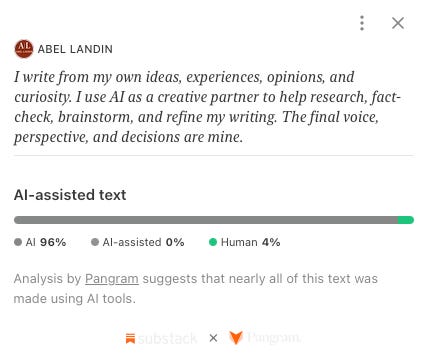
I ran this article through Substack’s AI scanner.
The result?
96% AI.
Not AI-assisted.
AI.
According to Pangram, only 4% of what you just read was human.
I laughed.
Because sitting directly above that result is my own disclosure explaining exactly how I write: the ideas, experiences, opinions, and curiosity are mine. I use AI as a creative partner for research, fact-checking, brainstorming, and refinement.
And I have the receipts.
The drafts, research, edits, rejected paragraphs, AI conversations, and probably more evidence of how this article came together than anyone would ever want to read.
Ironically, you just read some of that process. This article started with something I noticed, turned into a conversation about authorship, changed direction as I learned more, went through multiple drafts, got fact-checked, tightened, rearranged, and edited until I was satisfied with it.
Pangram saw the finished product.
It didn’t see any of that.
Maybe that’s where writing is headed, not proving that AI never touched our work, but being able to show what we brought to it.
So maybe the little AI robot peeking around the corner isn’t evidence that somebody cheated. Maybe it just means the writer wasn’t working alone.
Neither was Hemingway.
His editor just didn’t have a blinking cursor.
Further Reading
Dr. Sam Illingworth, “You Will Be Accused of Using AI. Here Is How to Prove You Wrote It.”
The Slow AI article
Substack, “How can I detect AI on Substack?”
Substack AI detection documentation
Anthropic, “How Claude marks AI-generated content”
How Claude marks AI-generated content
Google DeepMind, “SynthID”
Google’s explanation of its watermarking technology, including text.
Google DeepMind SynthID
Amazon KDP, “Content Guidelines”
This contains Amazon’s definitions of AI-generated and AI-assisted content and its disclosure requirements.
Amazon KDP Content Guidelines
U.S. Copyright Office, “Copyright and Artificial Intelligence, Part 2: Copyrightability”
This is the Copyright Office report behind our human-authorship discussion.
U.S. Copyright Office AI Report, Part 2
I’m reluctant to do anything with Claude again after this watermarking change. I occasionally run my poems through Claude, either done or already posted on Substack, just to get feedback or to proofread, as I often fail to catch little mistakes that are right in front of me. It will catch wobbly lines, if I’m rhyming, and will question me on punctuation. It may make a suggestion, but I never replace that suggestion with its verbatim line. I use it as a critic or an editor, just as I would use an online dictionary or a spell checker. I don’t trust Claude now, because I feel like it may take credit for what is my work. Frankly, it already does, by searching out articles from the internet and probably quoting them verbatim, as well. I feel that AI is a useful tool, and I really enjoy it when I can feed one of my poems into an AI music program and come up with a cool song. I guess there’s something wrong with that, too, because I didn’t do the elaborate performance and all the sound production and mixing myself. I feel like these detection programs are just another way for companies to make money and for Luddites to assert that their work is somehow better because they don’t use AI. Frankly, I don’t care if I like the finished product. Sometimes it helps me learn where I can do better.